Difficulty seeing at night or night blindness ,medically known as nyctalopia is a symptom.
There are two common terms ,symptom and sign of a disease. Symptom is what patient complaints and sign is what doctor finds in patient.
So night blindness is condition when patient finds difficulty in simple activities such as walking outside, driving, finding objects in a dim room, or moving between bright and dark places much harder. Some people notice that their eyes take longer to adjust when they enter a dark room, while others may struggle to see objects clearly when there is very little light.
Poor night vision can happen for several different reasons. It may be related to an uncorrected vision problem as in myopia cataract ,nutritional deficiencies as Vit A deficiency,which is easily corrected and patient responds very well.
Genetic eye conditions as retinitis pigmentosa which is progressive degenerative retinal disease.
There are two types of cells in the retina ,rods and cones. Rods are the photo receptor cells ,means these are the cells which are stimulated by light and we are able to see . In any disease of retina if these cells are degenerated so patient will not have normal response to light, or he needs more light to see. This impaired response due rods deficiency results in night blindness.
In our Modern Medicine this condition termed as progressive and non treatable. But at our Acu Eye Zone we have developed technique known as Assimilated Technique which an ISO Certified Technique we are successfully treating this rods deficiency night blindness condition. The results have been verified and published in the European Ophthalmology Journals
What Does Difficulty Seeing at Night Mean?
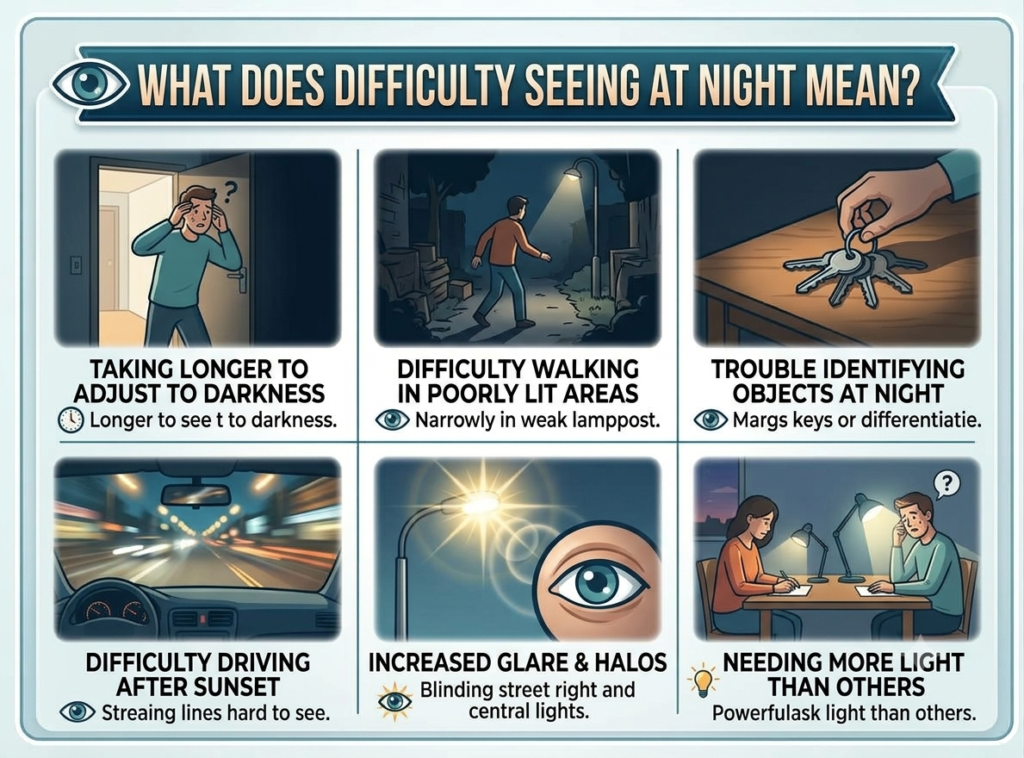
Difficulty seeing at night means having reduced ability to see clearly when the amount of available light is low. It can also include difficulty adjusting from bright surroundings to darkness.
You may notice problems such as:
- Taking longer to see after entering a dark room
- Difficulty walking in poorly lit areas
- Trouble identifying objects at night
- Difficulty seeing while driving after sunset
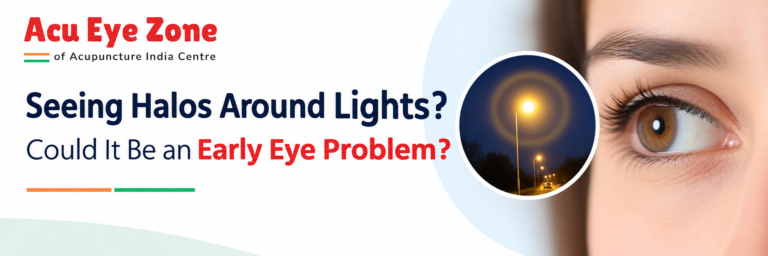
- Increased glare from headlights or streetlights
- Feeling that your vision becomes unclear in dim conditions
- Needing more light than other people to see comfortably
Night vision problems are not always caused by the same eye condition.Most common cause and easy to treat is Vit A deficiency , other causes are astigmatism can cause trouble seeing at night, while several other eye conditions can also affect vision in low-light situations. Diabetic retinopathy and genetic eye conditions.
What Causes Difficulty Seeing at Night?
There are several possible causes of poor night vision. Finding the exact cause usually requires a proper eye examination.
Uncorrected Vision Problems
Problems such as nearsightedness, farsightedness, or astigmatism can affect how clearly light is focused inside the eye. Astigmatism, in particular, may cause blurry vision, glare, and difficulty seeing at night.
If you already wear glasses but still struggle to see clearly at night, your prescription may need to be checked.
Changes in the Eye’s Lens
Changes in the lens can affect the way light passes through the eye. Some people may experience glare, hazy vision, or difficulty seeing clearly in low-light conditions.
A complete eye examination can help identify whether changes in the lens are contributing to your symptoms.
Retinal Problems
The retina is the light-sensitive tissue at the back of the eye. It helps the eye detect and process light.
Some retinal conditions can affect night vision, sometimes before a person notices more obvious changes in daytime vision. Night vision loss can also occur with certain inherited retinal disorders.
This is why ongoing night vision difficulty deserves professional evaluation rather than being assumed to be a normal part of aging. Retinitis pigmentosa is most common genetic eye condition night vision is impaired.
Why Does Night Vision Become Worse?
Night vision may become worse when the eyes are unable to receive, focus, or process available light effectively.
You may particularly notice the problem when:
- Moving from a bright area into darkness
- Walking through an unlit room
- Driving at night
- Looking for something in a dark environment
- Entering a cinema or dark building
- Experiencing glare from headlights
Some people may also notice difficulty with peripheral vision or navigating around objects in dim surroundings. These symptoms can provide useful information to an eye specialist during an examination.
When Should You See an Eye Specialist?
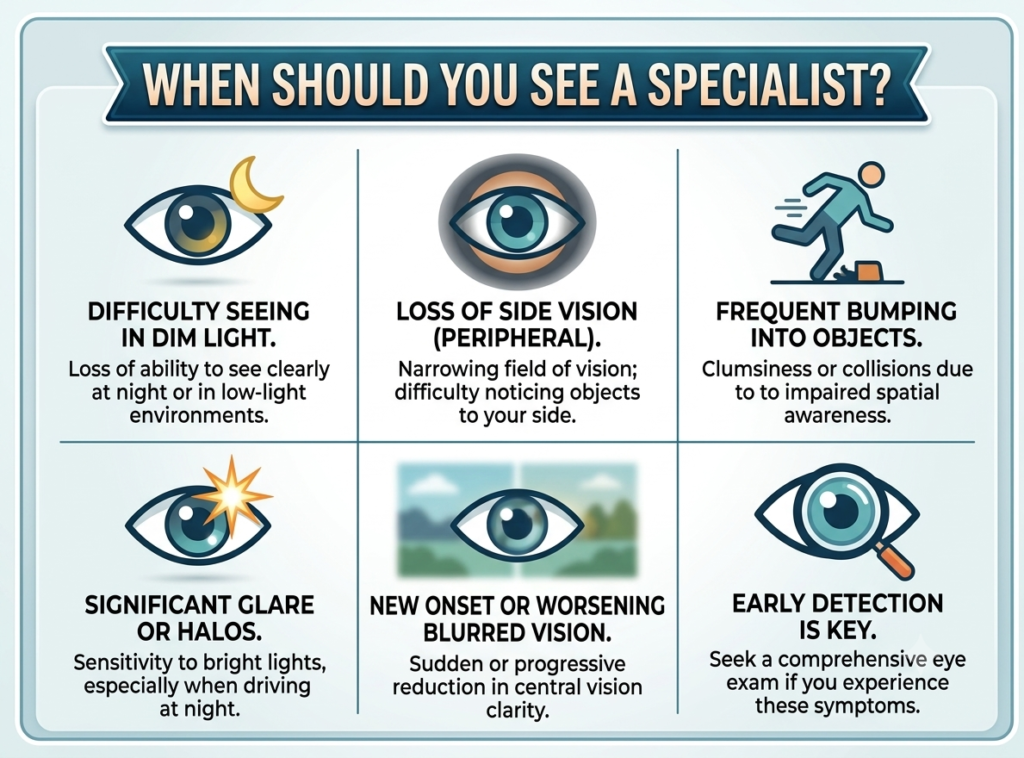
You should consider an eye examination if difficulty seeing at night is persistent, getting worse, or interfering with everyday activities.
It is especially important to seek professional advice if you also experience:
- Increasing difficulty seeing in dim light
- Loss of side vision
- Frequent bumping into objects
- New or worsening blurred vision
- Significant glare or halos
- Difficulty walking safely at night
- Changes in vision despite wearing prescribed glasses
How Is Poor Night Vision Diagnosed?
A doctor may begin with questions about when the problem started, whether it is getting worse, and how it affects your daily activities.
A comprehensive eye examination may include visual acuity testing, examination of the eye, and other tests depending on your symptoms. A dilated eye examination allows the doctor to look for eye diseases that may not be visible during a basic vision check.
A visual field test may also be useful when there are concerns about side or peripheral vision. Other specialised tests may be recommended when the doctor suspects a retinal or inherited eye condition.ERG Test is diagnostic for this.
The right tests depend on your symptoms and examination findings.
How Can You Manage Difficulty Seeing at Night?
The best approach depends on the underlying cause. There is no single solution that works for every person.
Your eye specialist may recommend appropriate glasses or contact lenses if a refractive problem is contributing to poor vision. If an underlying eye condition is identified, treatment or monitoring will depend on that condition. Advising for nutritional supplements is must if it is found.
For people experiencing low vision, practical changes can also make daily activities easier. Better lighting, increased contrast, larger text, magnification, and vision rehabilitation may help some people use their remaining vision more effectively.
At Acu Eye Zone, patients can discuss ongoing vision concerns with an eye-care professional and understand which examinations may be appropriate for their symptoms. A proper assessment is important before deciding on any treatment.
What Can You Do at Home to Improve Safety?
If you have difficulty seeing in low light, small environmental changes may make daily activities safer.
Consider:
- Keeping always stairways well lit
- Using night lights in bedrooms and bathrooms.
- Keeping frequently used objects in familiar places
- Removing obstacles from walking areas
- Using brighter, comfortable lighting for reading
- Always take eye rest working on long hours on computers, always use mobile phones and correct distance and angles. Increasing text size on phones and computers also helps.
- Taking extra care when walking outdoors after dark
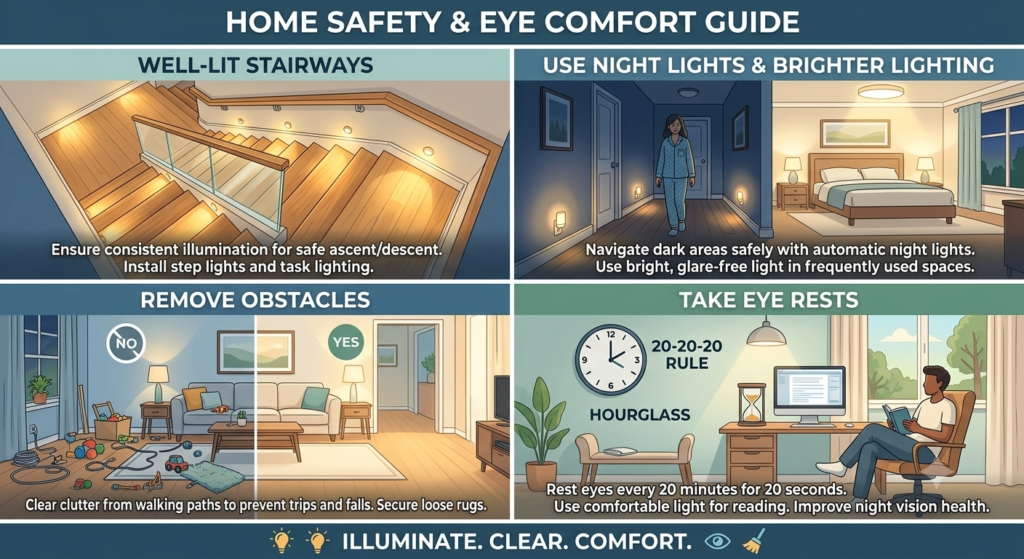
These steps do not treat the underlying cause, but they may make everyday activities easier for someone experiencing reduced vision. Low-vision guidance can include changes to home lighting, contrast, magnification, and digital settings.
Can Difficulty Seeing at Night Be Prevented?
Not every cause of poor night vision can be prevented. However, regular eye examinations can help identify vision problems and eye diseases.
If you already have changes in your vision, do not rely only on home remedies or assume that the problem will disappear. An eye examination can help determine whether the problem is related to your glasses prescription, the lens, retina, or another part of the visual system.
Early evaluation is particularly useful when symptoms are changing or affecting daily life.
When Should You Consider Specialist Eye Care?
If difficulty seeing at night is persistent, getting worse, or affecting your daily activities, it is important to get your vision evaluated by an eye specialist. A proper examination can help identify whether the problem is related to your eyesight, retina, or another underlying eye condition.
If your symptoms are linked to a retinal condition, you may also need specialised evaluation and ongoing management. Patients looking for Retinitis Pigmentosa Treatment in Delhi can consult Acu Eye Zone to understand their condition and discuss suitable care options based on their individual eye health.